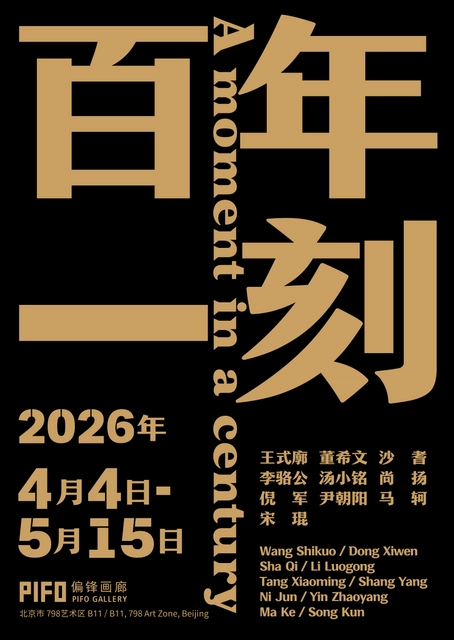
"A Moment in a Century" is a group exhibition brings together works by ten established artists—Wang Shikuo, Dong Xiwen, Sha Qi, Li Luogong, Tang Xiaoming, Shang Yang, Ni Jun, Yin Zhaoyang, Ma Ke, and Song Kun—aimed at to highlight those critical "moments" that, shaped and refined by the currents of history over the past century, have been crystallized and preserved within the medium of painting.
As Chinese artists gradually and meticulously adapted artistic tools and visual language of oil painting and printmaking to their own preference and recent historical conditions, presenting expansive and dynamic national subjectivities, this process initiates an extended dialogue between China and the world, and a vivid reflection of the profound transformations that defined 20th-century China. Among the artists presented in this exhibition, there are those who rendered the struggles for national independence, liberation, and the founding of a new society; those who engaged in audacious formal experimentation following the Economic Reforms of the 1990s; those who sojourned overseas and returned with renewed cultural consciousness; last but not the lease, those whose explored the frontiers of human intelligence that inspire new pictorial insights.
Across the fleeting passage of a century, the practices of these ten artists have strung together several interwoven trajectories. Coming from diverse regions across China, they bring distinct and diverse cultural wealth to a shared national memory. Although their upbringings have shaped their respective generational feats, their works—brought together in this exhibition—reveal striking continuities and convergences. They are both witnesses to and participants in their times, each engaged in a common endeavor: to capture, through their own vision and the act of painting, a singular "moment" of lived experience. In retrospect, from a global cultural perspective, each of them remains distinctly—and irreducibly—Chinese.
This "moment" marks the transition from ephemerality to eternity, bearing traces of the artist's labor imbued with emotional intensity, and stands as an imprint left from a historical era. This exhibition, in essence, pays tribute to these artists and visual thinkers.
The work of a painter conjures the innumerable moments of their life, and in turn contributes to the culmination of a civilization. Chinese artists have carried forward this legacy generation after generation. In times of national crisis, they mobilized artistic practice as a form of resistance, wielding brush and chisel as their instruments, producing songs of resilience within the tides of struggle and liberation of their time. Wang Shikuo and Dong Xiwen painted the critical moments of national emancipation and class revolution into iconic visual forms that have since been integrated into our collective memory. Meanwhile, Sha Qi and Li Luogong, having traveled through Europe and Japan in their youth, returned to China with expanded perspectives, engaging questions of national identity and cross-cultural artistic language. Building upon traditional materials, they developed distinctive formal vocabularies that introduced bold yet refreshing vitality into modern Chinese art.
Represented by Tang Xiaoming, a generation of painters trained in the early years of the People's Republic of China demonstrated remarkable mastery and depth in their oil painting practice.
Serving as a crucial link between past and present, they dedicated over three decades to articulating the ethos of workers, peasants, and soldiers, forging resilient and optimistic visual representations of the "new Chinese subject."
Shang Yang, an octogenarian, remains a formidable presence. Through both his own practice and his influence on successive generations of students, he has advanced diverse explorations of new pictorial languages. His large-scale works stand as exceptional exemplars of the evolving artistic landscape since the Reform era. Ni Jun, Yin Zhaoyang, and Ma Ke, of the 1960s and 1970s generations, have enjoyed a period of relative material abundance and global mobility; their overseas journeys undoubtedly enriched their painting practice with distinctive sensibilities and new aesthetic resources. Song Kun, with her exceptional talent and expressive command, effortlessly navigates the terrain of contemporary subjectivity, engaging in critical reflection and deconstruction of emergent identities. Without a question, each artist in this exhibition is acutely attuned to the urgency of capturing that "moment." Equally, they understand their own position confronted by the fleeting instant of a century, and by seizing the eternal at the right moment, they deliver a measure of what might be called "human agency."
A Moment in a Century