
Tip-Top on the Roof
By Fan Xinran
Those who inhabit modernity choose to exchange their lives for it, casting their time beneath clouds built of concrete—clouds that at times shield them from the scorching sun and at others turn into torrential rain. Some choose to depart from the rules of modern life, prising at roof ridges beneath the vault of the sky. Artists often assume this role. Working around his “nearby” , Tong Kunniao was prompted by a chance encounter to reconsider the sheet-metal roofs of villages on the suburb, distinct from their industrial concrete counterparts. He discovered another side of ordinary dwellings: beneath much the same sheet-metal roofs, artists, farmers, workers, and those engaged in various industries live under shelter, each bearing pressures and hopes. This renewed attention renders familiar dwellings strange, revealing their dual nature: even as the roof shelters us and allows us to settle, it limits the field of vision available to us.
The first gallery introduces the exhibition’s central concerns. A group of posthuman bodies breaks through the roof of a sheet-metal house sunk into the ground. Their bodies are assembled from inverted lampshades, mannequin fragments, and circuit boards; their lower halves are made of extruded polystyrene shaped by burning and carving. Foam encases their heads, their facial features barely identifiable. Beneath the lightwell, a frog-shaped wooden percussion instrument produces rhythmic sound of “gua gua”. Above the roof, bells circling over the bodies play an unsettling alarm.“Ding gua gua” (顶呱呱) is ordinarily an emphatic expression of praise, carrying overlapping tones of humour, ingratiation, reassurance, and numbing comfort. Within this exhibition, its meaning as a whole recedes, while the sonic and visual associations of “gua gua” give it an expressive force beyond signification. Ding (顶) refers both to the roof and to its extensions across different registers: the crown of the head, the boundary of an information cocoon, the threshold of a system, the end of art, the edge of the world. Functioning as both noun and verb, it names an upper limit while suggesting the act of pressing against it. It conveys the urgency of breaking through a threshold while bringing that threshold itself into view.
Tong’s recent works continue a practice in which mechanical installation and painting on silk take shape through one another. In the paintings, landscapes, flowers, and birds evoke traditional culture, forming an earthly panorama that merges with living forms in an increasingly fragmented and permeable manner. Branches, the veins of petals and leaves, blood vessels, and the radial patterns of irises gradually grow together on the silk. In the installations, posthuman bodies with faces covered in resin break free of the two-dimensional realm of rocks, flowers, and trees. They acquire a corporeal presence in physical space, assembled from technological objects, discarded materials, and living forms, only for painting to capture their elusive traces and imprint them back onto the plane. These reconstituted bodies convey a plaintive emotion in the paintings. Tears, glue, waterfalls, and other liquids flow indistinctly across the silk. Fragments of bodies and landscapes are joined through processes both natural and artificial, stitched together with needle and thread or linked by cobwebs that form over time. The faces’ lowered eyes and unfocused gazes suggest a tacit recognition of thresholds as persistent and unavoidable, an ambivalence towards the body’s expendability, and a latent courage to break through and begin anew. In a certain sense, these inherited cultural codes and symbolic conventions, rooted in flesh and blood, also seem to congeal into lesions within the body, enclosed by the boundary of skin and flesh. They are at once a nightmare and a warming, restorative remedy.
The boat-shaped installation, suspended over a bounded expanse of sea built from extruded polystyrene, will continue to drift above the very vault that once sheltered us. Yet this vessel is not Noah’s Ark: it will not sail towards an “away” without tradition, plastic, fungi, or viruses, but consciously extend the finite here. Its voyage began in Dionysus Departing Luoma Lake. Through our entanglement and interconnectedness within the broader actor-network, it compels us to reconsider the possibilities of symbiosis. These readymades, transformed through assemblage, rustle and stir in the art-making process: croaking beneath the roof, restless still above it.
—Excerpt from “Prising at Roof Ridges beneath the Vault Resounding with ‘Gua Gua’”
about the artist
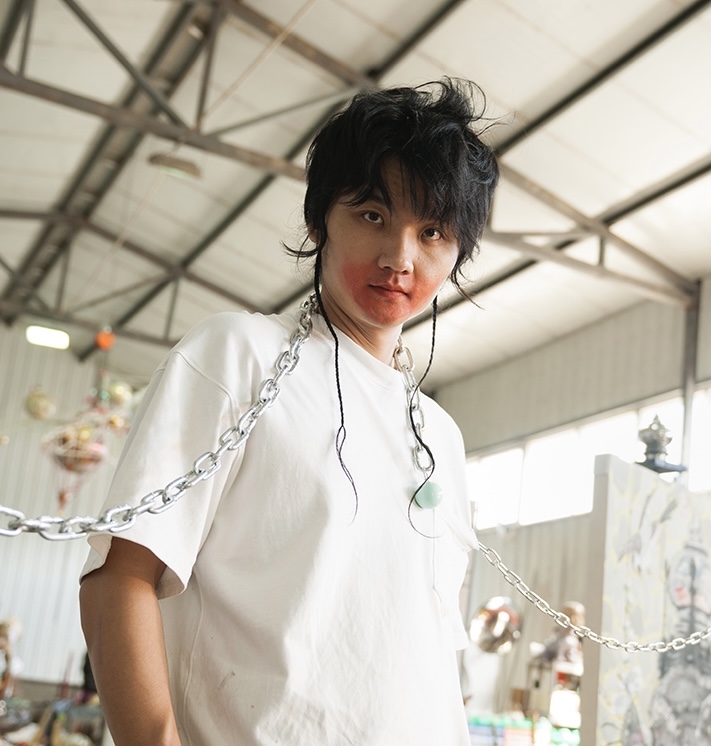
Tong Kunniao, born in 1990 in Changsha, Hunan Province, received his BFA from No.3 Studio, Department of Sculpture at the Central Academy of Fine Arts in 2015. He currently lives and works in Beijing.
Tong Kunniao works across installation, performance, video, sculpture, and painting. He is adept at using “excess products” generated by the modern world — a perpetual waste-making factory, and “leftovers” that have been found in resale shops, the flea markets or on the streets. He concerns about how the complex social structure has determined our social status and eaten up our individual identities. By decomposing ready-made objects and reassembling them in tandem or keeping them perfectly in balance, Tong aims to demonstrate the individual consciousness (the free spirit) behind the objects as well as the multiplicity and fragility of the system. In an era when commodity fetishism and symbol consumption are prevalent, and information is overloaded, Tong’s work extends beyond formal boundaries of reconstruction and presents it in a quirky and seemly absurd manner.
